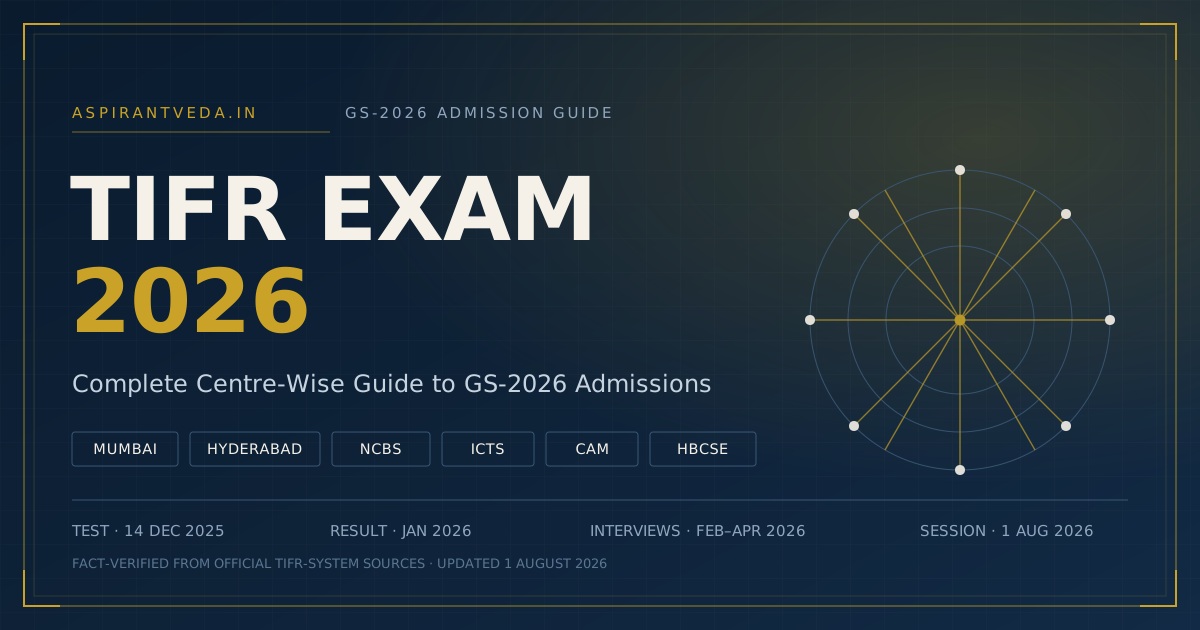
If you are looking for information about the TIFR Graduate School (GS) 2026 admission cycle, the most important thing to know is that the 2026 cycle is no longer an upcoming examination. The TIFR GS 2026 external examination was conducted on 14 December 2025, the programme start date was 1 August 2026, and TIFR has published final selection information for several centres and subject boards.
This guide has therefore been updated as a GS-2026 status and reference guide, while also explaining the admission structure, eligibility, examination route, syllabus, selection process, fellowship and preparation strategy that students can use when preparing for a future TIFR GS cycle.
Important: TIFR admission rules, programmes, eligibility, examination arrangements, fees and fellowship details can vary by subject, programme and admission year. Always check the latest official TIFR Graduate Studies notification before applying.
TIFR GS 2026: Quick Overview
| Particular | Details | Admission | TIFR Graduate School (GS) | Admission cycle | GS 2026 | Conducting institute | Tata Institute of Fundamental Research (TIFR) | External GS examination | 14 December 2025 | Programme start date | 1 August 2026 | Examination mode | External GS exam is online and MCQ-based | Application status | Closed for GS 2026 | Current status | Final selection information published by TIFR | Main programmes | PhD, Integrated PhD and selected MSc programmes | Official source | TIFR Graduate Studies |
|---|
TIFR GS 2026 Current Status
The GS 2026 admission process has already moved beyond the application and written-examination stages.
According to the official TIFR admission advertisement:
- The application portal opened on 27 September 2025.
- The final registration deadline was 11 pm on 26 October 2025.
- The external GS examination was held on Sunday, 14 December 2025.
- The programme start date was 1 August 2026.
TIFR has subsequently published the final answer keys, interview-shortlist information and final selection information for GS 2026.
The exact interview schedule was not identical for every subject or centre. For example, TIFR published separate interview dates for Chemistry, Physics, Mathematics, Biology, Computer Science and other subject boards.
What this means for students: if you are searching for the TIFR exam because you want to apply in a future cycle, do not use the old GS-2026 dates as upcoming dates. Wait for the next official TIFR admission notification.
What Is TIFR Graduate School Admissions?
For the most authoritative overview of the programmes and admission structure, students should also check the official TIFR Graduate Studies page before relying on third-party summaries. TIFR itself lists PhD, Integrated MSc-PhD and MSc programmes in certain subjects and provides the admission resources from the same portal.
TIFR Graduate School Admissions is the graduate admission route through which TIFR and participating centres admit students to research-oriented programmes.
TIFR describes its graduate programme as leading to PhD, Integrated MSc-PhD and MSc degrees in certain subjects. The exact programme and admission route depend on the subject board and centre.
The external TIFR GS examination is not best understood as one universal examination with identical rules for every discipline. The official TIFR pages provide subject-specific syllabus, examination instructions and admission information.
Major areas represented in GS admissions include
- Physics
- Chemistry
- Mathematics
- Biology
- Computer Science and Learning, Information and Data Science
- Science Education
- Wildlife Biology & Conservation
- Other centre-specific research programmes
The programme list should always be checked against the admission notification for the relevant year.
TIFR Centres and Research Locations
TIFR’s graduate admissions involve multiple centres and subject boards rather than a single campus-only admission system.
For GS 2026, official selection information includes programmes associated with:
- TIFR Mumbai
- TIFR Hyderabad
- National Centre for Radio Astrophysics (NCRA), Pune
- International Centre for Theoretical Sciences (ICTS), Bengaluru
- Centre for Applicable Mathematics (CAM), Bengaluru
- National Centre for Biological Sciences (NCBS), Bengaluru
- Homi Bhabha Centre for Science Education (HBCSE), Mumbai
The available programme differs from one centre to another. For example, the GS-2026 final-selection page lists Chemistry I-PhD and PhD selections at TIFR Mumbai, while TIFR Hyderabad also has Chemistry I-PhD/PhD selections listed.
Therefore, students should not assume that every subject or programme is available at every TIFR centre.
TIFR GS 2026 Programmes
The GS-2026 final-selection information shows that programmes were organised by centre and subject board.
Examples include:
| Centre / Subject | Programme examples in GS 2026 | TIFR Mumbai – Chemistry | I-PhD, PhD | TIFR Mumbai – Mathematics | I-PhD, PhD | TIFR Mumbai – Biology | I-PhD, PhD | TIFR Mumbai – Computer Science & LIDS | I-PhD, PhD | TIFR Mumbai/NCRA – Physics | I-PhD, PhD | TIFR Hyderabad – Chemistry | I-PhD & PhD | ICTS – Mathematics | PhD / centre-specific programmes | ICTS – Physics | I-PhD & PhD / other routes | NCBS – Biology | I-PhD & PhD | NCBS – Wildlife Biology & Conservation | MSc | HBCSE – Science Education | PhD |
This table is intended to show the structure of GS admissions, not to replace the official notification for a future admission year.
TIFR GS Eligibility
For programme-specific eligibility, use the official GS-2026 eligibility table (PDF). This is especially important because the qualifying degree, subject test and alternative examination route can differ between programmes.
Eligibility is programme-specific. This is one of the most important points students should understand before applying.
TIFR’s official eligibility page states that candidates in the final year of their qualifying degree can also apply, subject to the requirements of the programme for which they are applying.
Depending on the programme, qualifying degrees may include bachelor’s or master’s-level qualifications such as:
- BSc
- BS
- BE
- BTech
- BPharm
- MSc
- Integrated MSc
- MTech
- ME
- Equivalent qualifications
However, these qualifications are not a universal checklist for every programme. The relevant subject board’s eligibility conditions must be checked before applying.
Can final-year students apply?
Yes. TIFR explicitly states that candidates in the final year of their qualifying degree can apply, subject to the applicable programme requirements.
Can BTech students apply?
BTech/BE and other qualifying bachelor’s degrees can be accepted for certain Integrated PhD routes. The exact subject and programme eligibility must be checked in the official admission table.
Can MSc students apply?
MSc and equivalent master’s qualifications are relevant for several PhD programmes. The exact subject combination and other requirements depend on the programme.
TIFR GS Exam Pattern
Do not treat TIFR GS as having one identical examination pattern across every subject.
The official TIFR External GS Exam page describes the external GS examination as entirely online and MCQ-based.
For GS 2026, the official advertisement also shows that examination timing differed by subject. For example:
- Physics, Chemistry, Computer Science & LIDS and MSc Wildlife Biology & Conservation were scheduled in the morning session from 9:00 am to 12:00 pm.
- Mathematics for the PhD at CAM had a 9:00 am to 11:00 am session.
- Biology (JGEEBILS), other Mathematics programmes and Science Education were scheduled in the afternoon session.
This is why a generic statement such as “TIFR exam duration is always 2–3 hours with MCQs and numerical questions” should be avoided.
For future cycles, students should follow the subject-specific exam instructions released by TIFR.
TIFR GS Syllabus
TIFR maintains a dedicated Syllabus and Exam Instructions section with separate entries for:
- Biology
- Chemistry
- Computer Science & LIDS
- Mathematics
- Mathematics PhD at CAM
- Physics
- Science Education
- Wildlife Biology & Conservation
This is a better source for preparation than relying on a generic coaching syllabus.
TIFR Chemistry Syllabus
For Chemistry students, preparation should begin with the official Chemistry syllabus and examination instructions released by TIFR.
The preparation should cover the core areas expected from a strong undergraduate chemistry background, but students should use the official syllabus and previous papers to decide the exact depth required.
A useful preparation framework is:
Physical Chemistry
Focus on:
- Thermodynamics
- Chemical equilibrium
- Electrochemistry
- Chemical kinetics
- Quantum chemistry
- Statistical and molecular concepts
- Numerical problem solving
Organic Chemistry
Focus on:
- Reaction mechanisms
- Stereochemistry
- Organic structure and reactivity
- Spectroscopy
- Pericyclic reactions
- Important reaction classes
Inorganic Chemistry
Focus on:
- Coordination chemistry
- Chemical bonding
- Main-group chemistry
- Transition-metal chemistry
- Organometallic chemistry
- Bioinorganic concepts
Preparation note: These topic groups are a study framework, not a substitute for the official TIFR Chemistry syllabus. Always compare your preparation list with the current official syllabus before the next application cycle.
TIFR GS Previous Year Papers
If you are also preparing for other science entrance examinations, you may find our GATE 2025 Master Question Papers and Final Answer Keys useful for additional problem-solving practice, especially for Chemistry students considering GATE as another research-admission route.
Previous papers are one of the most useful resources for understanding the level and style of the examination.
TIFR provides a Past Question Papers section under its External GS Exam resources. The institute also publishes final answer keys for GS tests.
A good way to use previous papers is:
- Attempt the paper without looking at the solution.
- Record the time taken.
- Mark questions you could not solve.
- Categorise mistakes by topic.
- Identify conceptual gaps.
- Re-attempt difficult questions after revision.
- Maintain a topic-wise error notebook.
- Repeat older papers after a few weeks.
Do not use PYQs only as mock tests. Their bigger value is in showing you how concepts are tested.
TIFR GS Selection Process
If you are comparing TIFR with another research-oriented examination route, you can also read our GATE Exam 2026 guide for a separate overview of GATE eligibility, syllabus and examination structure.
The broad admission process involves examination/shortlisting followed by interviews or other centre-specific selection stages.
For GS 2026, TIFR published separate interview-shortlist information by centre, subject board and programme.
For example, Chemistry interviews for TIFR Mumbai were scheduled for 6–9 April 2026, while Chemistry interviews at TIFR Hyderabad were scheduled for 1–4 April 2026.
Other subjects had different schedules, and some programmes had additional written-test or centre-specific arrangements.
Therefore, students should not assume that every TIFR programme follows exactly the same interview format.
TIFR Fellowship and Stipend
TIFR’s official scholarship information currently states:
PhD
PhD students receive:
- ₹37,000 per month
- Increased to ₹42,000 per month after PhD registration
- Hostel accommodation or HRA as applicable
Integrated PhD
The official information states:
- ₹25,000 per month during the first year
- After satisfactory performance at the end of the first year: ₹37,000 per month
- After registration for PhD: ₹42,000 per month
The institute also specifies conditions related to qualifying-degree proof and provisional admission.
Because fellowship rules can change, students should verify the latest official scholarship page before making financial decisions.
TIFR GS 2026 Application Dates
The GS-2026 official schedule was:
| Event | GS 2026 date/status | Application portal opened | 27 September 2025 | Fee-waiver request deadline | 12 October 2025 | Priority for test-centre choice | 19 October 2025 | Final registration deadline | 26 October 2025 | Hall-ticket download | Mid-November 2025 | External GS examination | 14 December 2025 | Programme start | 1 August 2026 | Current status | 2026 cycle completed / final selection information published |
These are historical GS-2026 dates, not upcoming dates.
What about TIFR GS 2027?
As of the date of this article update, a GS-2027 admission schedule should not be presented as official unless TIFR has published it.
When the official notification is released, update this section with:
- application opening date
- fee-waiver deadline
- registration deadline
- hall-ticket date
- examination date
- interview schedule
- programme start date
Do not publish guessed dates as official dates.
TIFR Application Fee
For the GS-2026 external application, TIFR listed the following non-refundable application fees:
| Candidate category | Fee | Male candidates | ₹1,000 | Female candidates | ₹500 | Others | ₹500 |
The fee was payable online through the payment options provided by TIFR.
These figures belong to the GS-2026 cycle and should be rechecked when the next admission notification is released.
How to Apply for TIFR GS
When the next application window opens, students should use the official TIFR Graduate Studies application portal.
The general workflow is:
- Read the official admission notification.
- Check eligibility for your exact programme.
- Register on the application portal.
- Enter personal and academic information.
- Select the relevant subject/programme.
- Select the examination city where applicable.
- Upload the required photograph and signature.
- Apply for fee waiver if eligible and required.
- Pay the application fee.
- Review all information carefully.
- Submit the application.
- Save or print the submitted application for your records.
For GS-2026, TIFR specifically instructed applicants to prepare a passport-size photograph and signature. Applicants requesting a fee waiver were also required to provide the relevant recommendation letter.
TIFR Chemistry Preparation Strategy
For students preparing for multiple chemistry-related entrance examinations, our GATE 2025 Chemistry question-paper and answer-key resources can be used alongside TIFR papers to practice structured problem solving.
If you are preparing for TIFR Chemistry, do not approach the exam like a normal semester examination.
1. Build strong fundamentals
Start with concepts rather than memorising isolated formulas or reactions.
For Physical Chemistry, understand the mathematical meaning behind equations.
For Organic Chemistry, understand mechanisms and electron movement.
For Inorganic Chemistry, connect structure, bonding, periodic trends and reactivity.
2. Solve TIFR Chemistry papers
After each paper, classify questions into:
- Easy conceptual
- Moderate conceptual
- Multi-step problem
- Calculation-heavy
- Conceptual trap
- Topic not prepared
This tells you exactly where your preparation is weak.
3. Use textbooks selectively
You do not need to finish every famous chemistry textbook from cover to cover.
Instead:
- Use one main textbook for each major area.
- Use reference books for difficult topics.
- Use PYQs to decide which chapters deserve more attention.
4. Improve mathematical skills
Chemistry problems can require comfortable handling of:
- logarithms
- exponentials
- algebra
- graphs
- basic calculus
- approximations
- dimensional analysis
5. Practice without solutions
Do not look at the answer immediately.
Try the problem yourself, identify the exact point where you got stuck, and only then consult the solution.
Recommended Chemistry Books
The following books can be used as reference resources, but students should choose books according to their existing level.
Physical Chemistry
- Atkins’ Physical Chemistry — useful for building a strong conceptual foundation.
- Puri, Sharma & Pathania — useful for additional physical-chemistry practice.
Organic Chemistry
- Clayden, Greeves & Warren — Organic Chemistry — strong for mechanisms and conceptual understanding.
- Morrison & Boyd — Organic Chemistry — useful as a traditional reference.
Inorganic Chemistry
- Huheey — Inorganic Chemistry — useful for deeper conceptual understanding.
- J.D. Lee — Concise Inorganic Chemistry — useful for systematic revision.
Do not treat this list as an official TIFR booklist. TIFR does not require students to study a specific commercial textbook list.
Common Mistakes in TIFR Preparation
Avoid these mistakes:
- Preparing only from coaching notes.
- Ignoring previous-year papers.
- Memorising formulas without understanding them.
- Studying every topic at the same depth.
- Avoiding numerical problems.
- Starting interview preparation only after the shortlist.
- Assuming the examination pattern is identical every year.
- Using an old syllabus without checking the latest official instructions.
- Confusing one centre’s eligibility rules with another centre’s rules.
- Treating unofficial expected dates as confirmed dates.
Is TIFR GS Difficult?
TIFR GS is a research-oriented entrance route and requires strong conceptual preparation.
The important point is not simply that the examination is “hard.” The more useful question is whether you can solve unfamiliar problems using fundamentals.
A student preparing seriously should be comfortable with:
- conceptual questions
- multi-step reasoning
- quantitative problems
- unfamiliar applications
- time-limited problem solving
The best way to judge your readiness is to solve official previous papers under timed conditions.
Is GATE Compulsory for TIFR?
No universal statement such as “GATE is compulsory” should be made.
TIFR maintains a separate page covering GATE, JEST, CSIR and other examination routes, and the applicable route depends on the subject, programme and centre.
For example, the GS-2026 final-selection information includes Physics programmes associated with JEST/GATE/NET routes at some centres.
Therefore, if you want admission through a national examination score instead of the external GS examination, check the official eligibility table for your exact programme.
Frequently Asked Questions
Is the TIFR GS 2026 exam still upcoming?
No. The external GS-2026 examination was held on 14 December 2025. TIFR has also published final selection information for GS-2026.
When did the TIFR GS 2026 application form start?
The GS-2026 application portal opened on 27 September 2025.
What was the TIFR GS 2026 exam date?
The external GS examination was held on Sunday, 14 December 2025.
Is the TIFR GS exam online?
The official TIFR External GS Exam page describes the external GS examination as entirely online and MCQ-based.
Can final-year students apply?
Yes. TIFR states that candidates in the final year of their qualifying degree can also apply, subject to the relevant programme requirements.
Can BTech students apply for TIFR?
BTech/BE and equivalent qualifications can be eligible for certain Integrated PhD programmes. Eligibility must be checked for the exact subject and programme.
What is the TIFR Chemistry syllabus?
TIFR provides subject-specific syllabus and examination instructions. Chemistry students should use the official Chemistry syllabus together with previous Chemistry papers rather than relying on a generic MSc Chemistry syllabus.
What is the TIFR fellowship?
For the current official fellowship information, PhD students receive ₹37,000 per month, enhanced to ₹42,000 after registration. I-PhD students receive ₹25,000 in the first year, ₹37,000 after satisfactory completion of the first year, and ₹42,000 after PhD registration.
Is there an interview after the TIFR GS exam?
Shortlisted candidates are called for subject/centre-specific selection stages, including interviews. The exact schedule and process can differ by programme and centre.
Where can I find TIFR previous-year papers?
Use the official TIFR Graduate Studies website and its External GS Exam/Past Question Papers section.
Official TIFR Sources
Use these official pages for verification before applying:
- TIFR Graduate Studies
- TIFR GS 2026 Advertisement
- TIFR Eligibility
- TIFR External GS Exam
- TIFR Syllabus and Exam Instructions
- TIFR Application Fee
- TIFR Fellowship / Scholarship
- TIFR GS 2026 Final Answer Keys
- TIFR GS 2026 Interview Shortlists
- TIFR GS 2026 Final Selections
- TIFR GATE/JEST/CSIR/Other Exams
Final Takeaway
The most important thing about TIFR GS is that it should not be treated as a single generic entrance exam with identical rules for every student.
The programme, subject board and centre matter. Eligibility, examination arrangements, selection stages and alternative admission routes can vary.
For students interested in Chemistry, the best preparation strategy is to combine the official syllabus with previous TIFR Chemistry papers, strong undergraduate fundamentals and regular problem-solving practice.
For GS 2026, the application and examination stages are already over. If you are preparing for the next cycle, use this page as a reference and replace the dates, fee and other cycle-specific information as soon as TIFR releases the next official admission notification.
Disclaimer: Information on this page is based on TIFR’s published GS-2026 information and official Graduate Studies pages available at the time of the update. Admission rules, programmes, fees, examination instructions and fellowship amounts may change in future cycles. Always verify the latest official TIFR notification before applying.